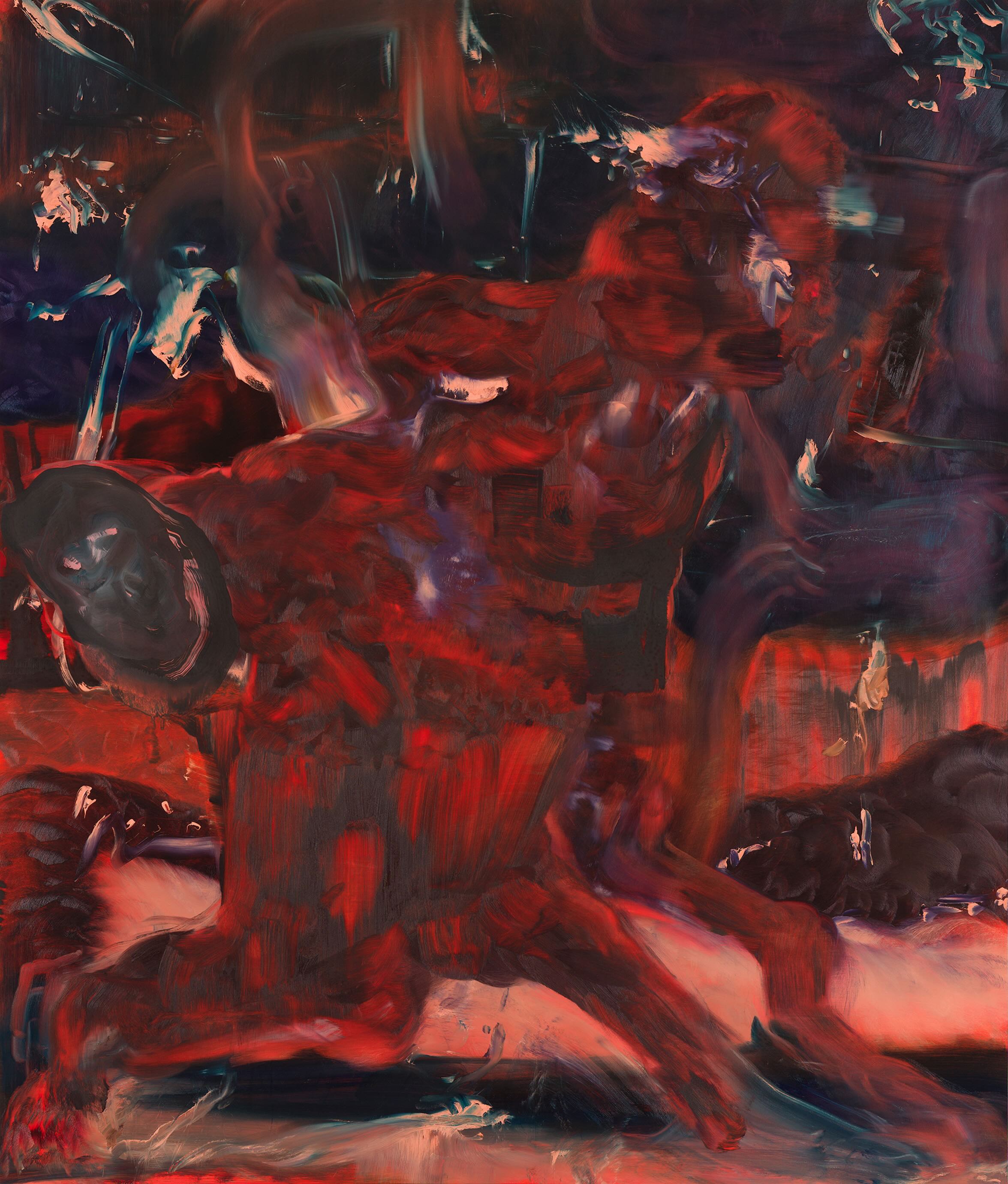
SETAREH is pleased to present the sixth solo exhibition of the German artist, Gregor Gleiwitz. The exhibition will take place in London, the artist's first exhibition in the Mayfair space. Opening on Thursday, April 30, 2026, the exhibition deepens Gleiwitz's distinctive painterly practice. His latest works unfold as sites of transformation, where the unstable nature of images comes to the surface.
Opening Reception: Thursday, 30 April, 2026
SETAREH London 2 Bourdon Street, Mayfair, London W1K 3PA
Gregor Gleiwitz’s work is deeply informed by art history and literature, drawing on a lineage that spans from early Netherlandish painting to modern and contemporary figuration. Echoes of Hieronymus Bosch and Pieter Bruegel the Elder resonate in his densely layered compositions, where hybrid forms, fleeting figures, and ambiguous narratives unfold. Like these predecessors, Gleiwitz constructs pictorial worlds in which the grotesque, the mythological, and the everyday coexist, yet his images resist allegorical clarity, remaining open and unresolved.
At the core of his practice lies a sustained inquiry into seeing itself. Gleiwitz has described an early, recurring mental image of himself seated on an eye, being situated both inside and outside of vision, simultaneously perceiving and being immersed within what is perceived. This counterposing position continues to inform his work as the paintings operate as thresholds between subject and object, interior and exterior, where vision becomes an active, generative force. Forms seem to emerge from within the act of looking, only to dissolve again, implicating the viewer in their continuous coming of being.
Gleiwitz’s paintings emerge through an intense, time-bound process: each work is executed within the span of a single day and night. This self-imposed temporal limit produces images charged with immediacy and physical presence. As noted by Dr. Gregor Jansen in his essay The Night of the Painter: Gregor Gleiwitz, Gleiwitz’s work resonates with the legacy of a “pandemonic” image world, one that oscillates between chaos and formation, between subconscious projection and painterly control. His compositions hover at the threshold where recognizable figures of faces, bodies, and creatures briefly stabilize from amorphous fields of color, only to retreat again. This dynamic aligns his practice with a lineage spanning from early Neo-Expressionism to contemporary explorations of the grotesque and the visceral.
Materially, the works balance density and dissolution. Layers are built, scraped, and reworked, producing surfaces that evoke organic processes, evoking flesh, landscape, or geological strata while simultaneously maintaining a certain optical flatness. The result is a tension between depth and surface, image and event. These apparitions induce a space that is at once ephemeral and psychological, recalling both the imaginative excess of historical painting and the existential intensity of Informel figuration.
In these new works, Gregor Gleiwitz further intensifies his engagement with the nature and temporality of painting. While his works are grounded in a highly intuitive and concentrated mode of production, the emphasis remains on the image as a site of encounter. Painting becomes a means of testing how forms come into being, how they persist, and how they disappear again. Gleiwitz’s canvases become arenas in which psychic, historical, and material forces converge, visualizing not static forms, but moments of emergence shaped by both control and contingency.